My Verdict
After using the Klymit Static V2 on real backpacking trips, I like it for what it is: a simple, affordable sleeping pad that keeps weight and packed size reasonable without giving up the comfort of an inflatable pad. I think it makes the most sense for warm-weather backpacking. It’s a great value and a budget-friendly sleeping pad. If you want to keep your gear budget under control rather than have the lightest premium sleep system, it’s worth it.
Its biggest strength for me is the combination of comfort, roughly one-pound weight, and very small packed size. The 23-inch width is also useful because it gives me more room than the traditional 20-inch backpacking-pad width without making the pad excessively heavy. I tested comfort, side sleeping, air retention, and durability particularly closely.
The major limitation is warmth. The Static V2 has an ASTM R-value of only 1.3, which Klymit itself places in the summer-use range. I therefore wouldn’t choose it as my primary pad for consistently cold nights.
Yes, I would buy it again and backpack with it again, but primarily for warmer trips where its low R-value isn’t working against me.
Klymit Static V2 at a Glance
| Specification | Klymit Static V2 |
|---|---|
| Current US list price | $74.99 |
| ASTM R-value | 1.3 |
| Published weight | 16.6 oz on current US listing; 16 oz / 454 g on current EU listing |
| My measured weight | To measure |
| Inflated dimensions | 72 × 23 × 2.5 in / 183 × 58 × 6 cm |
| My measured thickness | To measure if useful |
| Published packed size | 8 × 3 in / 20 × 8 cm |
| My packed size | To measure |
| Top fabric | 30D polyester |
| Bottom fabric | 75D polyester |
| Valve on my pad | To confirm from my exact version |
| Repair kit | Included |
| Best use after testing | Warm-weather hiking and backpacking where low weight, compact packing and value matter more than cold-weather insulation |
What I Like
- Very good comfort for the weight and price. After sleeping on it during backpacking trips, I think it provides a meaningful step up from minimal foam-pad comfort without becoming heavy.
- Excellent packability. This is one of its strongest features for me. It takes up surprisingly little room in my backpack once rolled down.
- Light enough for backpacking. Around one pound is reasonable for a budget inflatable pad, particularly given its full-length 72-inch design and 23-inch width.
- Useful 23-inch width. There is a little more sleeping room than on traditional 20-inch regular pads, while the raised side rails are intended to help keep you centered.
What I Don’t Like
- The R-value is the major limitation. At just 1.3, I consider this fundamentally a warm-weather pad rather than something I would rely on for consistently cold ground conditions. Klymit’s own guidance places R 1–2 in its summer category.
- Its 2.5-inch thickness leaves less margin than today’s thicker premium pads. How important that becomes depends heavily on sleeping position and inflation pressure.
How I Tested the Klymit Static V2
I tested the Klymit Static V2 over about 10 months and roughly 36 nights, using it on real hiking and backpacking trips rather than judging it from a few nights at home. Most of that use was inside my ALPS Mountaineering Lynx 1-Person tent, on both grass and rocky ground, which gave me a good mix of softer and more demanding surfaces. I usually paired it with my Kelty Cosmic sleeping bag, which also helped me judge the pad as part of the complete sleep system rather than in isolation.

I usually paired it with my Kelty Cosmic sleeping bag. I tested it in my normal sleeping positions, paying particular attention to comfort, pressure points, whether my hips or shoulders bottomed out, and whether the raised side rails actually helped keep me centered.
My newer pad uses Klymit’s flat Flip Valve, and I inflated it by mouth. I also monitored how well it held pressure overnight and inspected the valve, welded V-channels, perimeter seams, and underside for signs of leakage or wear.
The newer Static V2 is typically listed around 471 g / 16.6 oz, with a packed size of about 8 × 3 in. I have not used the Static V2 below ~35°F, so I won’t claim a minimum usable temperature based on somebody else’s trip.
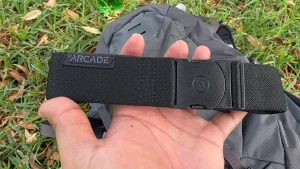
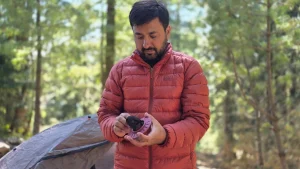
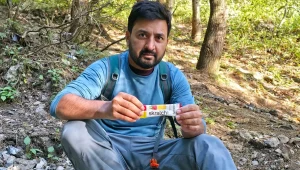
I tested the green Klymit Static V2 with the newer low-profile Flip Valve, rather than the older version that used the protruding Twist-Pull valve. I bought mine in 2025 from Amazon for $42.95. My pad also came with the Klymit-branded stuff sack shown in my photos.
The valve distinction is worth making because reviews of the Static V2 don’t always cover the same generation. Some testers used the older twist-style valve, while Klymit’s newer Static V2 uses the flat Flip Valve, as the model was updated with a modern valve system. For more on how I separate repeated field use from specifications and researched comparisons, see how I test and review hiking gear.
Hands-On Testing and Performance
Comfort: Do the V-Shaped Chambers Actually Work?
After roughly 36 nights on the Static V2, I find the V-shaped chamber design genuinely comfortable. I sleep on both my back and side, weigh about 76 kg / 168 lb, and normally leave the pad slightly softer rather than inflating it rock hard.
That softer setup works well for me because it lets the pad conform more naturally around my body without feeling excessively bouncy. The V-shaped air chambers also seem to control air movement better than a simple open air mattress. So, when I turn over, the entire pad doesn’t feel like it is shifting underneath me.

In my case, the V-shaped construction has not been a significant comfort issue during my nights on the pad. I have not bottomed out while side sleeping on the Static V2. At 76 kg, even with the pad slightly soft, my hip and shoulder have stayed off the ground during normal sleep.
That’s notable because this is one area where reviews disagree. Side sleeping was surprisingly comfortable. For me, the key appears to be finding the right pressure rather than maximizing firmness. Slightly soft has been more comfortable than making the pad rigid.
The raised side rails also work most of the time for me. Combined with the 23-inch width, they create a shallow cradle that helps keep my body toward the center when I turn between my back and side.
I can still move around normally, but I don’t regularly get the sensation that I’m about to roll off the edge. The wider-than-standard surface and raised perimeter are among the Static V2’s more successful comfort features.
Warmth: How Warm Is an R-Value 1.3 Pad?
The Static V2 is fundamentally a warm-weather pad because its ASTM R-value is only 1.3. After using mine across roughly 36 nights, I would treat warmth as its clearest limitation. I won’t assume that a good sleeping bag can compensate for the low insulation underneath me.
My coldest night so far was approximately 35°F, sleeping mostly inside my ALPS Mountaineering Lynx 1-Person tent with my Kelty Cosmic sleeping bag. The ground was grassy and rocky, and I did not notice cold coming specifically from beneath me. If you are building the rest of a value-focused sleep system, my budget backpacking sleeping bag guide covers the insulation that goes above the pad.

I consider about 43–50°F / 7–10°C a sensible baseline for this pad in summer conditions. Below that temperature, it is noticeably too cold compared with higher-R-value pads, according to other users. I have not pushed it into below-freezing conditions yet.
Ground temperature, soil moisture, sleeper metabolism, clothing, and the rest of the sleep system all matter.
What Does an R-Value of 1.3 Actually Mean? R-value measures resistance to heat flowing through the pad into the ground. This means higher numbers provide more insulation.
A warmer sleeping bag helps above and around me, but it cannot completely make up for inadequate insulation beneath me. REI notes that sleeping-bag temperature ratings assume a sufficiently insulated pad because the compressed insulation beneath your body provides relatively little protection from conductive heat loss into the ground.
For the Static V2, I judge warmth conservatively: excellent for genuinely warm trips, increasingly questionable as the ground gets colder.
Inflation and Deflation
The newer flat-valve Static V2 is quick to inflate, but getting every last bit of air out takes noticeably more work. On my pad, I normally need about 12–15 breaths and approximately one minute to reach the slightly soft firmness I prefer. After a long hiking day, it’s easy enough. I have never felt that inflation was a major setup chore.

The flat valve is one of the better improvements over older Static V2 versions. During inflation, its one-way section prevents noticeable air from escaping between breaths. So, I can stop partway without losing the pressure I have already added. I prefer mine slightly soft rather than completely rigid.

Deflation is less elegant. I found the narrow passages between the V-shaped chambers can trap the last pockets of air. It was significantly slower than inflation.
My normal method is that once I have forced the remaining air toward the valve and rolled it tightly, it’s easy to get back into the supplied stuff sack.
Weight and Packability
Klymit lists the Static V2 at 454 g / 16 oz, but I will use my own scale measurement here once I weigh my exact Flip-Valve pad. I plan to record two figures: the bare pad by itself and the complete trail package with the stuff sack and repair kit. That distinction matters because independent measurements don’t perfectly match Klymit’s published number.

Packability is one of the Static V2’s strongest backpacking qualities. Once rolled tightly, mine takes up very little space compared with bulkier foam or self-inflating pads. Klymit specifies 8 × 3 inches, and I noted the same packed dimensions. But the supplied stuff sack is quite tight.
Noise and Slippage
Noise has been very mild on the Static V2 and has never bothered me during roughly 36 nights of use. When I move from my back onto my side, there is some light fabric noise, but nothing I would describe as loud, crinkly, or disruptive enough to wake me.
I normally keep the pad slightly softer rather than fully inflated, which is also the pressure I find most comfortable. That may change how the surface feels and responds compared with using it completely firm, so my experience reflects how I actually sleep on the pad rather than a maximum-pressure test.
My Kelty Cosmic sleeping bag stays reasonably planted on the Static V2. I predominantly sleep on my back and don’t move around excessively during the night, so sliding has not been a meaningful problem for me. The raised side rails also help keep my body toward the center of the pad.
Overall, neither noise nor slippage has been a concern in my use. I can hear a little movement if I pay attention to it, but during normal sleep it is barely noticeable, and I’ve remained comfortable throughout the night.
Durability and Leak Testing
I specifically checked the failure points that show up in long-term owner reports: abrasion on the underside, leaks around the welded chambers, and problems with the valve. After roughly 36 nights over 10 months, my pad has held up surprisingly well.
The Static V2 uses 30D polyester on top and a tougher 75D polyester underside. This gives the ground-facing surface more abrasion resistance.

I’ve used mine on both grass and rocky campsites, although I don’t put it directly onto obviously sharp ground. On rocky sites, I clear stones and sharp debris before setting up and normally use the pad inside my tent. I’ve also slept on it outside the tent where there was good grass coverage between the pad and the ground.
After that use, I haven’t noticed cuts, pinholes, significant scuffing, or unusual wear on the underside. Considering its weight, the pad has felt surprisingly durable so far.
I also inspected the V-channel welds, outer perimeter, and raised side rails because weld-area leakage is one of the more specific failures reported by some Static V2 owners.
On my pad, I haven’t found any visible separation or concerning wear around the welds so far. After 36 nights, that is encouraging, although I’ll continue checking these areas as the pad ages.
My version uses Klymit’s newer low-profile Flip Valve. So far, the valve feels sturdy and works normally. It hasn’t become loose or difficult to close, and I haven’t noticed visible damage around the valve attachment. Based on my own use, however, neither the valve nor the welded construction has given me a durability problem yet.
Klymit Static V2 vs Other Sleeping Pads
The Static V2 isn’t the warmest or lightest pad available, but its combination of inflatable comfort, small packed size, and budget pricing is difficult to dismiss.
Klymit Static V2 vs NEMO Switchback
The NEMO Switchback is the better choice if simplicity and reliability matter more than cushioning. The current regular Switchback costs $59.95, has an ASTM R-value of 2.0, and is only 0.9 inches thick. Because it’s closed-cell foam, there is no valve to fail.
The Static V2 gives me a very different sleeping experience. At 2.5 inches thick and 23 inches wide, it offers substantially more cushioning than the 20-inch-wide Switchback. It also packs to just 8 × 3 inches. My biggest compromise is its lower R-value of 1.3. And I am also concerned about the possibility of an inflatable pad developing a leak.
For warm-weather backpacking where sleeping comfort and pack space matter most, I would choose the Static V2. If I wanted a pad that required zero inflation and tolerated rough treatment, the Switchback is a strong choice.
Klymit Static V2 vs Therm-a-Rest NeoAir XLite NXT
I haven’t tested the Therm-a-Rest NeoAir XLite NXT, so this comparison is based on specifications and independent research rather than my own trail experience with both pads.
The regular XLite NXT weighs just 13 oz / 370 g, yet has an R-value of 4.5 and is 3 inches thick. The Static V2 is around 16 oz, only 2.5 inches thick, and has an R-value of 1.3. Therm-a-Rest also includes a pump sack, stuff sack, and repair kit.
But the XLite’s MSRP is $199.95, compared with $74.99 for the Static V2, roughly $125 more at list price.
That extra money buys a much more impressive warmth-to-weight ratio. It makes the XLite a great choice for colder conditions and for backpackers aggressively reducing weight.
For warmer backpacking trips, I don’t think that I will get extra value by spending more on the expensive sleeping pad.
Is the Klymit Static V2 Worth It?
Yes, for warm-weather backpacking, I think the Static V2 offers very good value. It delivers real inflatable-pad comfort, low weight, and excellent packability without premium sleeping-pad pricing. After roughly 36 nights on mine, I have been comfortable and haven’t bottomed out at my 76 kg body weight. I haven’t experienced meaningful durability or valve problems so far.
At $42.95, I would buy it again without much hesitation. It has one of the strongest values in the sleeping-pad category. It combines reasonable comfort, durability, width, weight, and packability unusually well for the price.
The compromise is warmth, not basic usability. Its R-value of 1.3 puts it firmly in the warm-weather category. I would spend more if I regularly camped in colder conditions and needed a higher warmth-to-weight ratio.
The Static V2 doesn’t beat premium pads on specifications. Its strength is giving me enough performance for warm-weather backpacking that I don’t necessarily need to pay premium-pad money.
My Final Verdict
After roughly 36 nights over 10 months, I would buy the Klymit Static V2 again and would happily keep using it for warm-weather backpacking. At about 76 kg, sleeping mostly on my back and sometimes on my side, I’ve found it comfortable with slightly softer inflation. I haven’t bottomed out, and noise has been very mild. So far, the pad, welds, and Flip Valve have held up surprisingly well. Its compact packed size is another reason it continues to make sense in my backpack.
The limitation I wouldn’t overlook is warmth. With an R-value of just 1.3, this is fundamentally a summer-oriented pad. Independent field testing reaches essentially the same conclusion: it’s a sensible warm-weather baseline rather than something to expect true three-season insulation from.
I would spend more if I regularly backpacked in cold spring/fall conditions, at colder high elevations, or near freezing. That’s where a substantially higher R-value becomes much more important. Premium pads can also provide more insulation for similar or even lower weight. But for the warm conditions where I’ve actually used it, the Static V2 gives me enough comfort and packability that I don’t feel compelled to pay premium-pad prices.